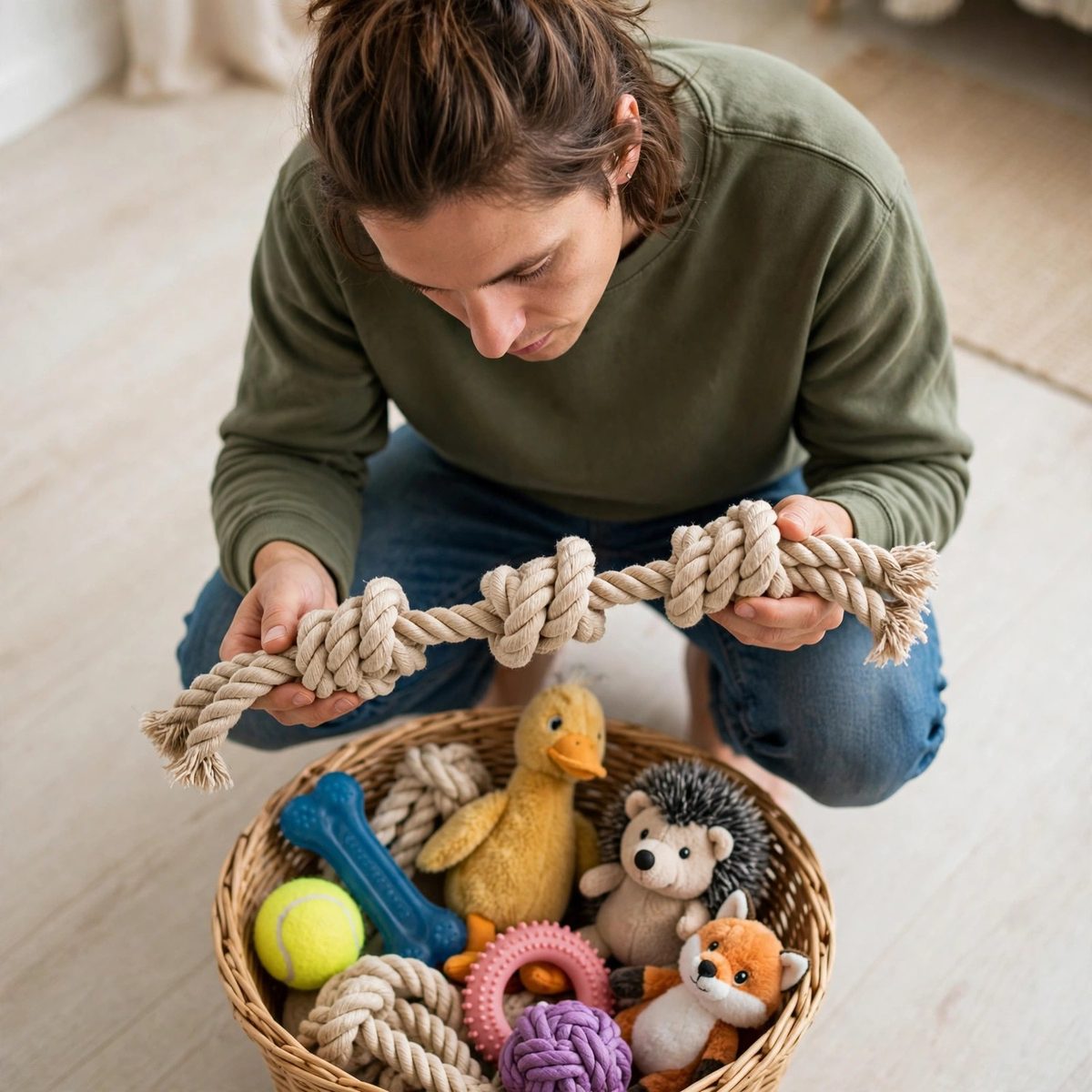
Toys are meant to be chewed, chased, tugged, and carried, which means they wear out. A toy that was fine last week can develop a crack, a loose seam, or a thin spot that needs attention today. This article explains how to check toys, supervise play, clean different materials, and rotate toys so play stays safe and interesting without a constant stream of replacements.
Why Toy Checks Matter
Dogs and cats play hard. They bite, pull, shake, and carry toys in ways that stress seams, knots, and surfaces. A small tear can grow quickly during a single session, and a loose piece can become a swallowing risk if it is not noticed. Regular checks take less than a minute and prevent most problems. Make checks part of the routine: look at a toy before you offer it, glance at it during play, and check it again when you put it away.
Checks also help you learn which toys suit your pet. A toy that shows wear after one session may be too light for your pet's play style, while a toy that looks untouched after a week may be too hard, too large, or too unfamiliar. Use those observations to adjust the next purchase rather than buying the same toy again out of habit.
Supervision: Stay Nearby During Play
Stay nearby during chew sessions, tug games, wand play, and puzzle time, especially with a new toy. Supervision lets you step in if a toy starts to break apart, if play gets too rough, or if a pet tries to swallow a piece. Put toys away between sessions so play stays structured and toys last longer. Supervised play also helps you learn which toys your pet enjoys most and which ones to rotate out.
Supervision does not mean hovering. Sit nearby, read a book, or work in the same room while your pet plays. Glance over every minute or two, and step in when you see hard chewing in one spot, pulling at seams, or attempts to swallow a piece. For cats, supervision means watching wand play and putting string toys away between sessions, since string and ribbon should never be left within reach unsupervised.
Checking Different Toy Types
Rubber toys need a squeeze-and-bend check. Squeeze the toy, bend it gently, and look for cracks, thinning walls, and sharp edges. If the rubber feels sticky, brittle, or soft in one spot, retire the toy. Check grip grooves and textured surfaces, where cracks often start. A quick rinse after outdoor play keeps grit from wearing down the surface.
Rope toys need a knot-and-strand check. The BouncePup Knotted Rope Tug Toy, 3 Knot uses thick cotton rope with three knots, which makes wear easy to spot: look for thinning, fraying, and loose strands. Tug knots gently to confirm they still hold firm. Retire any rope that has thinned, shed long strands, or developed a loose knot. Rinse rope toys after outdoor play and let them dry fully before storage, since damp rope can hold odor.
Plush toys need a seam-and-squeaker check. Look at belly seams, ear joins, and tail bases, where stress concentrates. Check for loose stitching, torn fabric, exposed fill, and squeakers that have shifted or become exposed. Retire any plush toy with a split seam or an exposed squeaker. For tug toys, check handles and joins as well: the WiggleWhisk Rope Ring Tug Toy uses a closed rope circle, so look for thinning along the full ring and retire the toy if any section feels weak.
Puzzle toys and feeders need a hinge-and-well check. Look for cracked compartments, loose lids, and sliders that stick or wobble. Check wells for trapped food, and clean the toy before the next use. Retire any puzzle with a cracked compartment or a loose part that could be chewed off.
Cleaning by Material
Clean rubber and plastic toys with warm water and mild soap, rinse well, and let them air-dry fully before the next use. Rope toys can be rinsed in the same way, though thick knots take longer to dry, so plan ahead. Fabric mats and fleece pieces need a shake-out and a full air-dry so they do not hold moisture or odor. Plush toys can be spot-cleaned with mild soap and water, then air-dried fully; flat plush toys dry faster than thick stuffed shapes.
Clean toys on a regular schedule, not only when they look dirty. A weekly clean for daily-use toys and a clean during every rotation swap keeps toys fresh. Check squeakers and seams after washing, since wet fabric can hide small tears that become visible once the toy dries. Store clean, dry toys in a basket or bin rather than leaving them in a pile on the floor.
Rotation: Keeping Play Fresh
Rotation keeps toys interesting and slows wear. A practical rotation has three roles: a daily chew or active toy, an interactive toy for games with you, and a comfort or solo toy for quiet time. Put two or three toys out at a time, keep the rest in a basket, and swap them every few days. Wash toys during the swap so each rotation starts clean.
Watch which toys your pet chooses first after a swap. Those favorites deserve a place in every rotation, while toys that sit untouched for a week may need a different setting or a different play style. Try offering an ignored toy in a new room, pairing it with a short training session, or using it during a calm moment rather than a high-energy game. If a toy still goes untouched, set it aside and try a different texture or shape next time.
Rotation also helps with multi-pet homes. Give each pet a toy during group play so no single toy becomes a point of tension, and put toys away when play ends. If one pet guards toys, offer separate play sessions in different rooms and pick up all toys between sessions. Structured rotation reduces conflict and keeps play positive.
When to Retire a Toy
Retire a toy when you see cracks, sharp edges, loose pieces, split seams, exposed fill or squeakers, thinning rope, or wear that makes the toy small enough to fit in your pet's mouth. If you are unsure, retire the toy. A replacement costs far less than a vet visit, and a fresh toy often renews interest in play. Keep a spare on hand so a retirement does not leave your pet without a play option.
Keep a simple retirement rule: when in doubt, throw it out. That rule removes the guesswork and keeps play consistent. With regular checks, supervision, cleaning, and rotation, most toys last longer, play stays safer, and your pet gets a fresh set of options every few days.
Multi-Pet Homes and Shared Toy Baskets
In homes with more than one pet, label a small basket per pet or keep separate rotation sets so each animal has toys sized for its own mouth and play style. Offer toys in separate spots during group play, watch for guarding signals such as stiffening or hovering over a toy, and end group sessions before tension builds. Wash shared toys more often, since they collect saliva and dirt from several animals. With separate sets and calm supervision, shared play stays friendly and each pet keeps access to toys that fit.